
Drawing MC samples from the surrogate posterior#
Once the learning loop has converged, drawing Monte Carlo samples from the surrogate model can be done at a very low computational cost.
Note
By default, an MC sampler will have already been run at convergence for diagnosis purposes.
The simplest way to create an MC sample from the surrogate model is to call the generate_mc_sample() method of the Runner object. This method can be called any number of times, and the previous samples will be overwritten.
The MC algorithms available are the same nested samplers used by the NORA acquisition engine (see Installing Nested Samplers), as well as the MCMC sampler from Cobaya.
To generate new MC samples with default settings (uses the best nested sampler available by default):
runner.generate_mc_sample()
To retrieve the last generated samples, use the last_mc_samples() method. By default, it returns the samples as a dictionary. A pandas DataFrame can be generated as:
mc_samples_dict = runner.last_mc_samples(as_pandas=True)
print(mc_samples_dict)
       w    logpost  logprior   loglike       x_1       x_2
0    1.0 -11.598237 -5.991465 -5.606773  4.896665  4.535424
1    1.0 -11.286758 -5.991465 -5.295293  1.117008 -0.148755
2    1.0 -11.262597 -5.991465 -5.271132  4.806402  4.460790
3    1.0 -10.672167 -5.991465 -4.680702  4.313618  1.246258
4    1.0 -10.670824 -5.991465 -4.679360  2.068655 -1.042577
..   ...        ...       ...       ...       ...       ...
237  1.0  -7.570368 -5.991465 -1.578904  3.024982  2.123483
238  1.0  -7.570094 -5.991465 -1.578629  3.067862  2.078437
239  1.0  -7.569896 -5.991465 -1.578432  3.056808  1.987092
240  1.0  -7.565576 -5.991465 -1.574112  2.979181  1.981701
241  1.0  -7.565178 -5.991465 -1.573713  2.996010  1.998560

[242 rows x 6 columns]
Samples are also stored by default in the same folder as the checkpoint, inside a chains sub folder. The order of the columns in that file is weight log-posterior param_1 param_2 ....
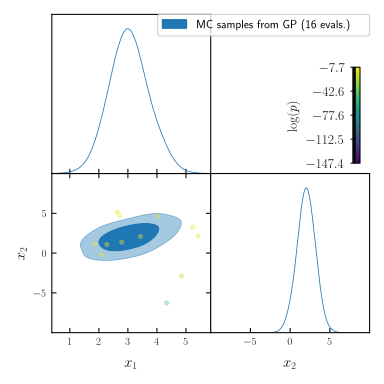
To plot the results of the MC sampler, you can load these samples into your favourite analysis/plotting package, or use the plot_mc() method:
runner.plot_mc(add_training=True)
How to draw finer MC samples#
Since sampling from the surrogate posterior can be done at a very low cost, it may be worth re-running the final MC sample with higher precision:
If using a nested sampler, increasing
nliveandnum_repeats, withdmeaning a factor of the dimensionality, and reducing theprecision_criterionfor the convergence of the evidence integration:runner.generate_mc_sample( sampler={"nested": {"nlive": "100d", "num_repeats": "10d", "precision_criterion": 0.005}} )
If using Cobaya’s MCMC sampler (faster, produces more samples), decreasing the Gelman-Rubin
R-1test limits for means and covariances:runner.generate_mc_sample( sampler={"mcmc": {"Rminus1_stop": 0.005, "Rminus1_cl_stop": 0.05}} )
Can one draw samples from the surrogate likelihood instead?#
The Runner class implements the logL() method as the reconstructed log-likelihood from the surrogate log-posterior. This should return a close approximation to the true likelihood within the prior bounds, except, in the case of non-uniform priors, for regions where the prior density is very low.
Thus, conversely, if the targeted support is well contained within the prior bounds of the surrogate model, one can pass the logL() method to an MC sampler to produce samples using a different prior.