
Introductory example#
Note
The code for the example is available at ../../examples/introductory_example.ipynb and ../../examples/introductory_example.py
Step 1: Setting up a likelihood function#
Let’s start with a very simple example where we want to characterize a 2d-Gaussian Likelihood:
We want to sample from the posterior within a uniform prior square \([-10, 10]\).
We need to define a log-likelihood function, which is the modelling target for GPry and the prior bounds:
import numpy as np
from scipy.stats import multivariate_normal

mean = [3, 2]
cov = [[0.5, 0.4], [0.4, 1.5]]
rv = multivariate_normal(mean, cov)

def logLkl(x, y):
    return rv.logpdf(np.array([x, y]).T)

bounds = [[-10, 10], [-10, 10]]
Step 2: Creating the Runner object#
The Runner object manages model specification and the active sampling loop of GPry up to convergence. A didactic intro to this process can be found in section How does GPry work. The Runner object also implements some post-processing and tests.
To initialize it, we pass it the log-likelihood function as first argument, and the prior bounds as the second argument (or via the bounds keyword). More complicated prior specification can be passed by defining and passing as first argument a Cobaya Model (see Cobaya interface for GPry).
Optionally, we can also pass a path where to save checkpoints via the checkpoint argument. If passed, in order to prevent loss of data, you must specify a checkpoint policy, either load_checkpoint="resume" or load_checkpoint="overwrite"). If set to "resume" the runner object will try to load the checkpoint and resume the active sampling loop from there; if set to "overwrite" it will start from scratch and delete checkpoint files that may already exist.
from gpry import Runner
checkpoint = "output/intro"
runner = Runner(logLkl, bounds, checkpoint=checkpoint, load_checkpoint="overwrite")
In this example we will leave to their default values all training parameters: the choice of GP, acquisition function, convergence criterion, options of the active sampling loop…
Step 3: Running the active learning loop#
Since all training parameters are chosen automatically all we have to do is to call the run() method of the Runner object:
runner.run()
This runs the active sampling loop until convergence is reached. It also saves the checkpoint files after every iteration and creates progress plots which are saved in [checkpoint]/images/ (or ./images/ if a checkpoint was not defined).
Once converged, you can access the surrogate model and use it as a function for any purpose.
Note
Internally GPry models the log-posterior, not the log-likelihood.
To get the surrogate log-posterior or log-likelihood you can call respectively logp() or logL(), passing each a single point, or a (nsamples, ndims) array of locations where you want to evaluate the surrogate.
Let us compare the GPry surrogate model and the true likelihood at (1, 2). Both evaluations should produce similar numbers.
point = (1, 2)
print(f"True log-likelihood at {point}:      {logLkl(*point)}")
print(f"Surrogate log-likelihood at {point}: {runner.logL(point)[0]}")
Step 4: Monte Carlo samples from the surrogate posterior#
As part of a final test before convergence, GPry will have run a Monte Carlo sampler on the surrogate model. If everything went well, you can use that sample as you would with one obtained with a traditional MC sampler: to extract marginalized quantities, create a corner plot of it, etc.
If a checkpoint has been defined, samples are stored in that same folder, inside a chains sub folder, in one or more .txt files. In those files, the order of the columns is weight log-posterior param_1 param_2 ....
Note
If you would like to repeat this process to get a finer sample, you can generate a new one by calling the generate_mc_sample() method with some options for the sampler:
runner.generate_mc_sample(sampler={"nested": {"nlive": "50d"}})
The last MC sample can be retrieved with the last_mc_samples() method:
runner.last_mc_samples(as_pandas=True)
It should produce something like:
                  w        logpost      logprior           loglike           x_1            x_2
0     6.484375e-108    -259.771915     -5.991465       -253.780450     -9.847782       6.090650
1      1.962129e-98    -237.931479     -5.991465       -231.940014     -8.458978       8.142535
2      4.161785e-83    -202.630838     -5.991465       -196.639374     -9.756148       0.557772
3      1.769460e-82    -201.173572     -5.991465       -195.182108     -8.368915       5.245021
4      7.961933e-79    -192.751869     -5.991465       -186.760405     -7.870831       5.892725
...             ...            ...           ...               ...           ...           ...
1232   2.705340e-03      -7.561122     -5.991465         -1.569657      2.989332       1.986725
1233   2.705458e-03      -7.561078     -5.991465         -1.569614      3.002605       2.014129
1234   2.705503e-03      -7.561062     -5.991465         -1.569597      3.004512       1.995828
1235   2.705524e-03      -7.561054     -5.991465         -1.569589      2.998646       2.009283
1236   2.705533e-03      -7.561051     -5.991465         -1.569586      2.997139       1.988815

1237 rows × 6 columns
Now that we have MC samples, we can process and plot them the same way that we would do with any other MC samples.
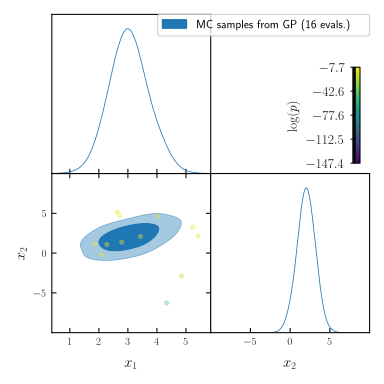
The easiest way to get a corner plot is to call the plot_mc() method, which will generate a GetDist corner plot (it includes the training set unless passed add_training=False).
runner.plot_mc()
Step 5: Bayesian evidence#
When a nested sampler is used to generate samples from the surrogate model (it is, by default), GPry can provide an estimation of the Bayesian evidence of the model as the evidence of the mean of the Gaussian Process regressor. The associated standard deviation is that of the log-evidence computation using the nested sampler, and it does not include possible modelling errors by the GPR or the infinities classifier. For well-converged cases, it should be a reliable estimate regardless.
Let us compare the current estimate with the actual value (here the inverse of the prior volume, since the likelihood is normalized in parameter space):
print(f"NS log-evidence     = {runner.last_mc_logZ()[0]} +/- {runner.last_mc_logZ()[1]}")
print(f"Actual log-evidence = {np.log(1 / np.prod(np.array(bounds)[:, 1] - np.array(bounds)[:, 0]))}")
NS log-evidence     = -5.823306518451101 +/- 0.180457722963657
Actual log-evidence = -5.991464547107982
Bonus: Getting some extra insights#
You can do further plots about the progress of the active-learning loop using:
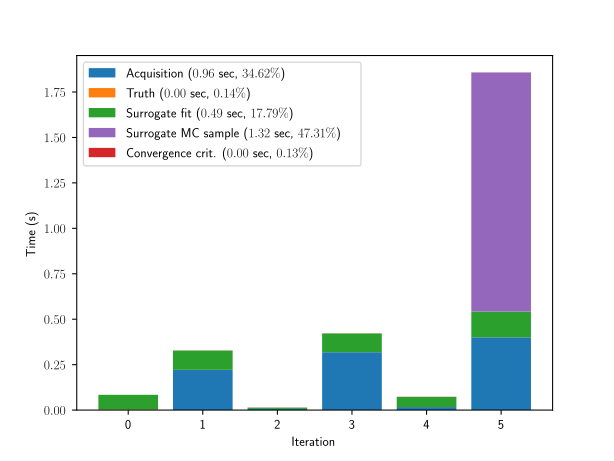
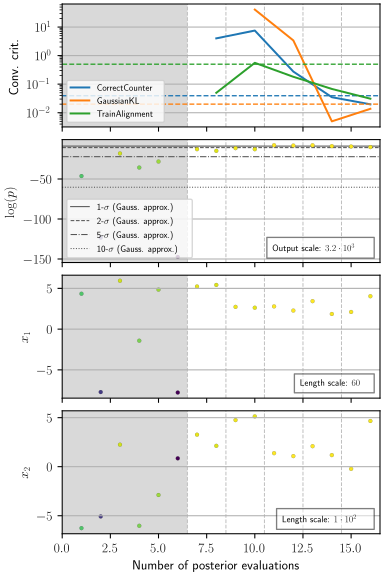
runner.plot_progress()
If you call this method without any arguments it produces the following plots:
a histogram of the time spent at different parts of the code.
if the run has converged, a corner plot of the final MC sample showing the training set (the same one you get when calling
plot_mc()).a convergence history (“trace”) plot showing, as a function of posterior evaluations, the value(s) of all convergence criteria, the distribution of posterior values, and the distribution of samples per model parameter.
Validation#
Note
This part is optional and only relevant for validating the contours that GPry produces. In a realistic scenario you would probably not be able to run a full MCMC/NS on the likelihood, and would need to follow instead the validation guidelines at Strategy and troubleshooting.
Lastly, to compare our contours to the true Gaussian, we draw 10000 samples from it, set them as fiducial samples in the Runner, and plot the result:
truth_samples = rv.rvs(size=10000)
runner.set_fiducial_mc(truth_samples)

runner.plot_mc()
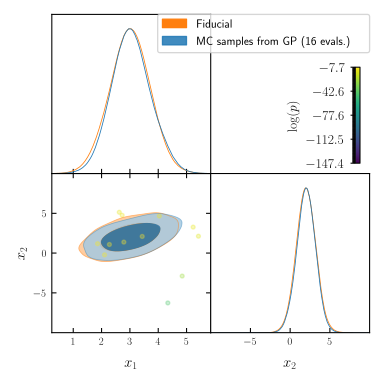
As you can see the two agree almost perfectly! And we achieved this with just a few evaluations of the posterior distribution!